Why Recline Tension Has to Match Your Weight
- Oliver McAbbot
- 2 days ago
- 8 min read

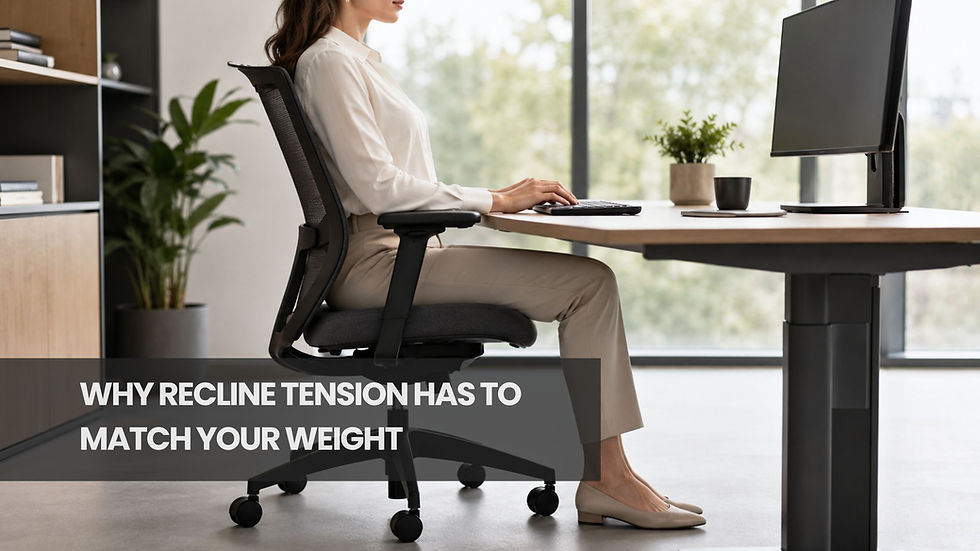
You lean back and lurch. A light person settles into a new chair, tips backward to relax, and the backrest barely gives before springing them upright again, so they spend the day sitting forward and fighting a spring built for someone heavier. Someone larger sits in the same chair, leans back to open up their hips, and finds the recline already at its limit, pinned upright with nowhere left to go. Same chair, opposite complaints, and the fix is one knob almost nobody turns.
The reason both people are uncomfortable is recline tension. A premium ergonomic chair uses a spring inside the tilt mechanism that resists the backrest as you lean, and a tension knob under the seat winds that spring tighter or looser to match your body weight. The physics is a balance of torque: the spring has to push back with roughly the force your upper body applies as you lean, so a light user needs a soft spring and a heavy user needs a stiff one. Set for the wrong weight, the same mechanism that should carry a lean instead throws a light user forward or locks a heavy user upright, which is why the tension knob has decided recline comfort on every well-built chair sold long before 2026 and still does. Understanding why recline tension has to match your weight turns a chair that fights you into one that follows you.
Why the Spring Has to Match Your Body Weight
Recline is a balance between two forces, which is the whole reason the spring is adjustable. When you lean back, the weight of your torso pivots around the tilt mechanism and tries to push the backrest down, while the spring pushes the other way to hold you. If the spring pushes with the same force your torso applies, you float at whatever angle you stop at and the chair feels weightless. If the spring pushes harder than your torso, it wins and shoves you back upright. If it pushes softer, your torso wins and you fall backward faster than you meant to. The tension knob exists to set that spring force to your body, because a fixed spring can only ever match one weight.
This is why the same chair feels completely different to two people, and why the tension setting matters more than the number of features on the spec sheet. A heavier torso applies more leaning force, so it needs a stiffer spring to balance it, and a lighter torso applies less, so it needs a softer one. The mechanism does not know who is sitting in it; it only knows how tight the spring is wound. This dependence of feel on the spring, rather than on the frame or the padding, is exactly what separates the good tilt mechanisms from the crude ones, the point explored in the tilt mechanism difference that separates a premium chair from everything else.
Why a Light User Gets Thrown Forward
A light user suffers because the factory spring is usually wound for an average or heavier body, so it out-muscles them. When a small person leans back, their torso applies only a modest force, but the stiff factory spring pushes with far more, so the moment they relax their legs the spring wins and springs them back upright. The result is a chair that feels like it is resisting every lean, so the user gives up reclining and sits perched forward on the front of the seat all day, which is the posture the recline was meant to relieve. Winding the tension knob down softens the spring until it matches their lighter torso, at which point the same chair suddenly reclines smoothly. The fix is the knob, not a different chair, which is why the tension control is one of the adjustments that quietly decides comfort, exactly the sort covered in the adjustments on a premium chair that most people never touch.
How Recline Tension Feels at Different Settings
Because the feel depends entirely on how the spring matches your weight, it helps to see the pattern. The table below maps the tension setting against your body to how the recline behaves.
Tension vs your weight | What the spring does | How the recline feels |
Far too stiff | Out-muscles your lean | Throws you upright, cannot recline |
Slightly too stiff | Wins gently | Fights every lean, springs you back |
Matched to your weight | Balances your torso | Floats at any angle, weightless |
Slightly too soft | Loses gently | Falls back faster than intended |
Far too soft | Cannot hold you | Drops back suddenly, feels unsafe |
Read down the table and the matched setting is the only one where the chair holds you at whatever angle you choose, because only there does the spring force equal your leaning force. Every other row is the spring being too strong or too weak for your particular body, which is a setting problem, not a fault in the chair. The way the recline moves at each setting is far clearer to watch than to read, which is what the chair walkthroughs on YouTube show.
Why a Heavy User Cannot Recline
A heavier user has the opposite problem: the factory spring, even at a middling setting, is often too soft to balance their torso, so the mechanism cannot hold them and the chair reaches the end of its travel almost immediately. Because their torso applies a large leaning force, a spring wound for a lighter body simply gives way, the backrest sinks to its stop, and the user ends up pinned at the mechanism’s mechanical limit rather than floating at a comfortable angle. It feels like the chair barely reclines, when in fact the spring is being overwhelmed. Winding the tension knob up stiffens the spring until it can hold the heavier torso partway through the travel, restoring the ability to stop at any angle. This is why a heavy user should always wind the tension to its firmer end before deciding a chair does not recline, the kind of setup a well-built premium office chair is designed to allow.
When Recline Tension Matters Less
In fairness, recline tension does not always decide comfort, and it is worth saying when it matters less. For a user who never leans back and works fully upright at the desk all day, the spring is barely loaded, so its setting changes little. For a chair used in short bursts, there is not enough reclining time for a mismatched spring to cause fatigue. And for a body weight that happens to sit near the factory default, the spring may already be close enough that the knob makes only a small difference. So recline tension matters most for a user who leans back through a long day and whose weight sits away from the default, and less for an upright worker, brief use, or an average-weight user on a well-chosen chair. The point is not that everyone must obsess over the knob, but that a chair that seems to recline badly is usually just wound for the wrong weight, rather than a chair to give up on.
Common Mistakes
The first mistake is never touching the tension knob at all. Most people sit in the factory setting for years, blaming the chair for throwing them forward or refusing to recline, when the spring is simply wound for a different body. The knob is there to match the spring to your weight, and until you turn it the recline cannot suit you.
The second is blaming the chair instead of the setting. A light user calls the chair too stiff and a heavy user calls it too weak, but both are describing the same spring set for the wrong weight. The recline is a balance of forces, so the fix is the setting, not a new chair.
The third is winding the tension while already leaning back. The spring is under load then, so the knob turns hard and the change is hard to feel. Set the tension while sitting upright with the backrest unloaded, then lean back to test, and adjust again in small steps.
The fourth is expecting one setting to suit two people. If two bodies of different weight share a chair, the spring cannot balance both at once, so each has to reset the tension when they sit down. A shared chair needs the knob turned, not a compromise setting that suits neither.
Conclusion
Recline tension has to match your weight because recline is a balance between the force of your leaning torso and the force of the spring pushing back. When the spring matches your weight, the two forces cancel and you float at any angle you choose, but when the spring is too stiff it out-muscles your lean and throws you upright, and when it is too soft your torso overwhelms it and you drop back or hit the stop. A light user gets thrown forward by a spring wound too hard, and a heavy user cannot recline because the spring is too soft to hold them, and both are describing the same mechanism set for the wrong body.
The tension knob exists precisely so that one spring can serve many weights, which is why it is the adjustment that quietly decides recline comfort while sitting ignored under the seat. Wind it down if the chair springs you upright, wind it up if the chair sinks to its stop, and set it while upright so the spring is unloaded. It matters most for a long day of leaning and a body away from the default, and less for an upright worker or brief use. So before you conclude that a chair reclines badly, reach under the seat and turn the one knob that decides whether the chair fights your lean or follows it.
Frequently Asked Questions
What does the recline tension knob actually do?
It winds the spring inside the tilt mechanism tighter or looser, changing how hard the backrest pushes back as you lean. Recline is a balance between the force of your leaning torso and the force of that spring, so the knob sets the spring to match your body weight. Turn it up and the spring resists more, suiting a heavier body; turn it down and it resists less, suiting a lighter one. It is the control that decides whether the recline holds you comfortably or fights you.
Why does my chair throw me forward when I lean back?
Because the spring is wound too stiff for your weight, so it out-muscles your lean. When your torso applies less force than the spring pushes back with, the spring wins the moment you relax and springs you upright, which feels like the chair rejecting every attempt to recline. This is most common for lighter users on a spring set for an average or heavier body. Winding the tension knob down softens the spring until it matches your torso and the recline settles.
Why can a heavier person barely recline in the same chair?
Because the same spring that is too stiff for a light person is often too soft for a heavy one. A heavier torso applies a large leaning force, so a spring wound for a lighter body gives way and the backrest sinks straight to its mechanical stop, which feels like the chair barely reclining. Winding the tension up stiffens the spring until it can hold the heavier torso partway through the travel, restoring the ability to stop at any angle rather than being pinned at the limit.
How do I set the recline tension correctly?
Sit in the chair upright with the backrest unloaded, then wind the tension knob to a starting point and lean back to test. If the chair springs you upright, wind it down; if it drops back too fast or hits the stop, wind it up. Adjust in small steps until you can lean back and stop at any angle without the chair pushing you or dropping you. Setting it while upright makes the knob easier to turn and the change easier to feel.
Can two people share a chair with different weights?
They can, but each has to reset the recline tension when they sit down, because one spring setting cannot balance two different torsos at once. A setting matched to a heavier person will throw a lighter one forward, and a setting for the lighter person will let the heavier one sink to the stop. In a shared chair, treat the tension knob like the seat height, as something each user adjusts on sitting down rather than a single compromise that suits neither.
Is recline tension the same as the recline lock?
No. The tension knob sets how hard the spring resists your lean, matching the spring to your weight, while the recline lock fixes the backrest at a chosen angle so it stops moving. Tension decides how the recline feels while it is free to move, and the lock decides whether it moves at all. You set the tension to your body first so the free recline feels balanced, then use the lock only if you want to hold a particular angle for a while.


Comments